"Whoever wants to recognise correctly must first have doubted correctly."
The pain trigger is then probably different from what was suspected. Previous diagnoses need to be scrutinised. We replace the concept of a single pain trigger with the idea of a pain map with several pain triggers. In the pain workshop, we get to the bottom of possible causes together with you. Only this understanding enables a change of course towards sustainable therapeutic success.
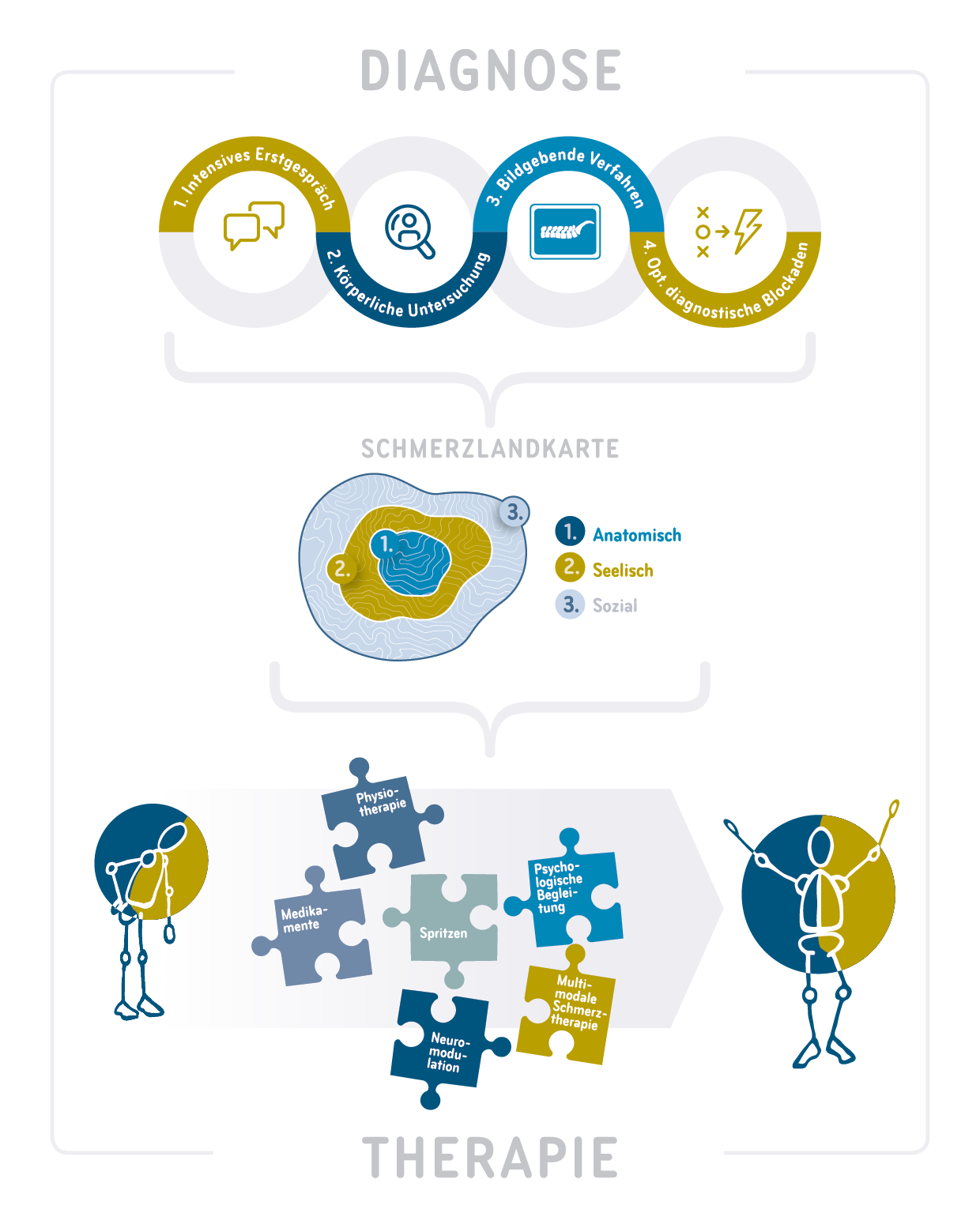
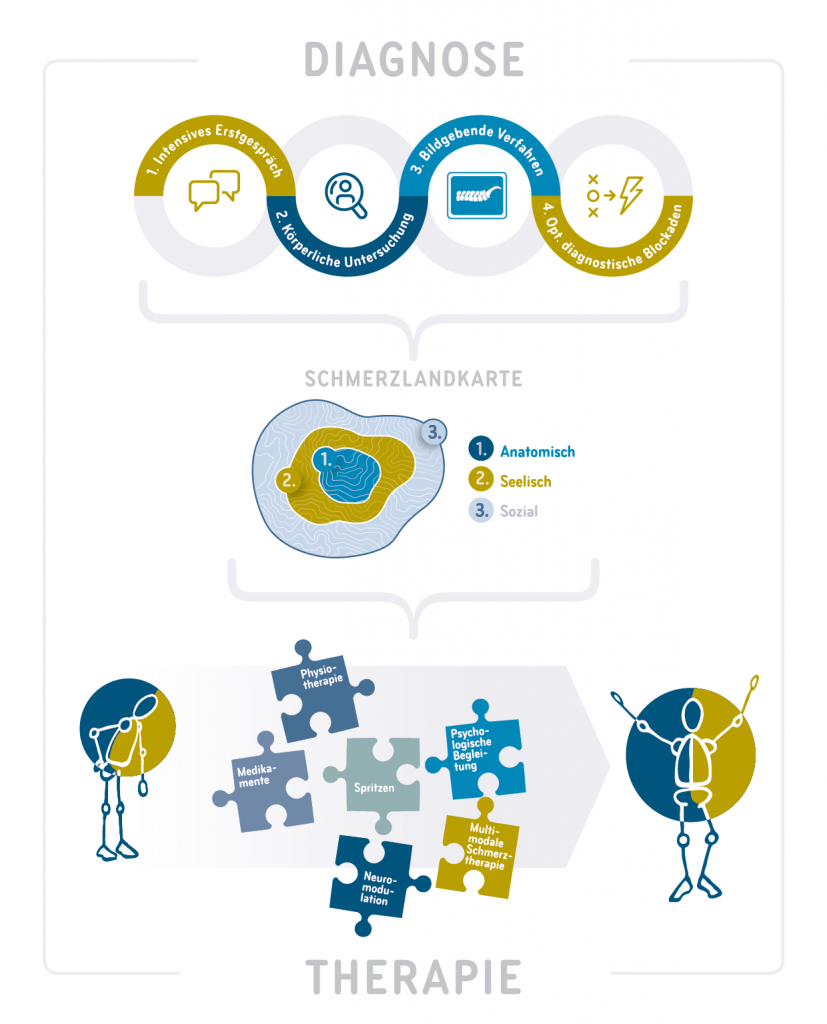
At the end of the consultation, we want to know your symptoms and understand your problem. To do this, we will work through a catalogue of questions with you so that nothing is overlooked. You will also have time to tell us about yourself and your symptoms. Details that have so far remained in the dark will certainly also be important. We view each of our patients as an individual, embedded in a complex network of biological, psychological and social factors. We are aware of the connection between stress and pain. The Munich Back Pain Model, which we developed ourselves, forms the basis of our diagnostics and takes into account the complexity of your pain. We have state-of-the-art hardware and software at our disposal to analyse the images you bring with you. The images are viewed and discussed with you. You can ask us important questions at the end of the initial consultation.
Even in the age of high-resolution imaging, the classic physical examination has lost none of its importance. For the examiner, the aim is to "understand" the pain in the literal sense of the word. Every physical examination of the spine includes orthopaedic and neurological techniques. For example, painful trigger points or muscular tension can be identified immediately with the appropriate sensitivity. Each of our physical examinations also includes a preliminary assessment of the neighbouring regions, such as the hip or shoulder region, in order to identify concomitant orthopaedic conditions.
Even the most modern magnetic resonance imaging cannot visualise pain directly. Imaging procedures only show changes in body structures that can - but do not necessarily have to - be associated with pain with a certain degree of probability. For example, herniated discs can be detected in around half of all septuagenarians without back pain. Imaging procedures are therefore essential for detecting anatomical changes. On the other hand, their evaluation depends on the individual symptoms and the experience of the doctor. Radiologists and radiographers lack knowledge of their patients' symptoms and examination findings. They therefore do not make diagnoses, but describe deviations from the norm in their reports. In the pain workshop, if necessary, we have our radiological colleagues take images, discuss them with you and evaluate them with regard to possible correlations with your complaints.
Diagnostic blockages have hardly become widespread in Germany. Wrongly so. This is because they are essential in determining pain triggers. The reason: local anaesthesia of individual structures such as nerves, vertebral joints or trigger points makes it possible to precisely identify the source of pain, which in turn enables accurate treatment.
No effective treatment without a precise diagnosis: many of our patients have already been treated several times without the desired success. Surgical measures have also failed to achieve a lasting improvement.
The pain trigger is then probably different from what was suspected. Previous diagnoses need to be scrutinised. We replace the concept of a single pain trigger with the idea of a pain map with several pain triggers. In the pain workshop, we get to the bottom of possible causes together with you. Only this understanding enables a change of course towards sustainable therapeutic success.
Whoever wants to recognise correctly must first have doubted correctly."
Aristotle
At the end of the consultation, we want to know your symptoms and understand your problem. To do this, we will work through a catalogue of questions with you so that nothing is overlooked. You will also have time to tell us about yourself and your symptoms. Details that have so far remained in the dark are certainly also important. We view each of our patients as an individual, embedded in a complex network of biological, psychological and social factors. We are aware of the connection between stress and pain. The Munich Back Pain Model, which we developed ourselves, forms the basis of our diagnostics and takes into account the complexity of your pain. We have state-of-the-art hardware and software at our disposal to analyse the images you bring with you. The images are viewed and discussed with you. You can ask us important questions at the end of the initial consultation.
Even in the age of high-resolution imaging, the classic physical examination has lost none of its importance. For the examiner, it is all about "understanding" the pain in the literal sense of the word.
Every physical examination of the spine includes orthopaedic and neurological techniques. For example, painful trigger points or muscular tension can be detected immediately with the appropriate sensitivity.
Each of our physical examinations also includes a preliminary assessment of the neighbouring regions, such as the hip or shoulder region, in order to identify concomitant orthopaedic diseases.
Even the most modern magnetic resonance imaging cannot visualise pain directly. Imaging procedures only show changes in body structures that can - but do not necessarily have to - be associated with pain with a certain degree of probability. For example, herniated discs can be detected in around half of all septuagenarians without back pain.
Diagnostic blockages have hardly become widespread in Germany. Wrongly so. This is because they are essential in determining pain triggers. The reason: local anaesthesia of individual structures such as nerves, vertebral joints or trigger points makes it possible to precisely identify the source of pain, which in turn enables accurate treatment.
Dear patients,
As a certified pain therapy centre, we are subject to the quality assurance agreement for pain therapy of the National Association of Statutory Health Insurance Physicians, which applies from entered into force on 01 October 2023.
For you and us, this means that we must work together to ensure that all of our patients receive the German pain questionnaire and later only Fill in progress questionnaires.
We are aware that the German Pain Questionnaire is very detailed and therefore long, which can take up a lot of time and could be perceived as annoying.
Please note that this is a is a legal obligation, which we must fulfil.
This process makes a significant contribution to best possible Quality of care for you.
This task also involves a considerable amount of work for our team, be it in the form filling, analysing or storing the questionnaires.
We would like to thank you for your understanding and assistance.
Together we can optimise your treatment.
Yours sincerely,
Your team at the Schmerzwerkstatt Munich
 English
  German
  Russian